Freshwater: Theatre & Audience

THEATRE AND AUDIENCE | Freshwater

Precis

As part of the Theatre & series, this volume does not so much pursue original research as it provides comprehensive overview and compilation of existing scholarship on audience. In many ways, however, it is also a comprehensive overview of lacuna in that existing scholarship. Freshwater argues that theatre scholarship by and large avoids speaking directly to audience—out of habit, or elitism—and could benefit greatly from adding interview practices to its methods.

Above all, this is a work that valorizes nuance. Audiences do not have a unified experience. Critics are not representative of the general population. Performances shift from night to night, and are often inflected by audience, etc.


Chapter Outline

Introduction

  • Orthodoxy: connection between audience participation and political empowerment. (3-4)
    • Why do scholars make claims about theatre’s influence/impact without evidence to support?
    • Why do scholars rely on their own experience and that of critics, without include audience voices?
    • Is this related to suspicion of / frustration with audiences? Why?

Barriers to understanding theatre and audience

  • Orthodoxy: Tendency to confuse individual and group response, exaggerated and unsubstantiated claims about theatre’s influence/impact (5)
    • Audience of individuals bring their own cultural references, political beliefs, sexual preferences, personal histories, immediate preoccupations
      • i.e.: coexisting audiences
    • Individuals are also not limited to a single experience
      • Ex: Alice Rayner experiences a play as a professor, as a mother, as a bourgeois (6)
  • Elin Diamond: “The Violence of ‘We'”: critics’ use of “we” falsely unify audience response, or reduce it down to a single point

Models and frames: readership, spectatorship, embodiment, affect

  • Marvin Carlson: Theory often regards audience as passive, fails to consider how audiences learns to respond (11)
  • Barthes “Death of the Author”
    • Stanley Fish supports this with the idea that perceived value of the text derives from community interpretation > intrinsic qualities (13)
  • What reader response theory lacks: that audience may influence delivery of performance; theatre as social event lends to “active resistance” (15)
  • Ranciere (“Emancipated Spectator”) argues against intellectual passivity (16)
    • That trend is largely past. Belief in active interpretation on the part of the spectator. (17)
  • Audience not limited to “looking”: Simon Shepherd on body, Beckermen on the kinesthetic, Lepecki on The Senses in Performance, Merleau-Ponty on embodiment (18-19)
  • Kershaw on applause as engaging in the fantasy of theatre spectatorship as “receiving a gift,” a ritual of hegemonic submission (20-21)
    • Difficult, of course, to engage in that ritual post-radical performance
  • Phelan engages in her own affective/emotional experience, shows analysis itself is creative, highlights individual experience (23-24)
  • Scholarly bias towards riots as seductive suggestion of importance of theatre in social spheres—creates blind spots? (26-27)

The road less travelled: asking the audience (rather than the reviewers)

  • Tracy and McConachie 1998 Theatre Survey dedicated to audience research
  • Cultural studies rejects audience as homogeneous entity, theatre studies lagging behind (28) —is this still true??
  • Marketing departments talk to audiences through focus groups, interviews, surveys—not so scholars (30)
    • These surveys elicit demographic information more than production content, however (Olsen) (30)
  • Media studies concept of audiencing: audiences constructed by institutions, dicourses, interpretive frames (32), e.g: conscripted student audiences
  • Problems with critics: “old white men,” regular theatre-goers (34-35)
  • Suspicion frustration, and contempt: attitudes towards audiences
    • Plato: anxiety that subjectivity and identity are destabilized by unending alterity of theatrical role-play (39)
    • Barish: theatre evokes mixture, contamination, blurring boundaries (41)
    • On the flip side: actors ambivalent towards audience. But what about stage fright? (43)
      • Ridout: Stage fright as a modern phenomenon, interfacing with financial dependence of actor and temporal dependence of audience (43)
    • Engineering confrontation
      • Brecht against Verfremdungeffekt (distancing effect) (47)
      • Rebellato charts shift from acceptance of audience as arbiter to frustration with audience failure to appreciate (49)
      • Playwright Howard Barker valorizes presenting audience w/ ambiguity (53)
  • Potent orthodoxies: participation and empowerment
    • Boal and forum theatre creates new orthodoxy that participation = empowerment
      • Often applied reductively, uncritically (56)
    • Bishop: “the tasks facing us today are to analyze how contemporary art addresses the viewer and to assess the quality of the audience relations it produces” (qtd 60-61)
  • Playing with the audience: uneasy interactions
    • Blue Man Group as subversive and desired: notably, audiences are coerced rather than invited; complicity assumed (65)
    • Abercrombie and Longhurst: being an audience member is no longer exceptional, but part of everyday life (70)
    • Signs that we trust audiences more: Blast Theory, marketing dept engagement with “scratch nights” (ie audience workshops) (72-73)
      • Is age an assumed factor here in increased trust in audiences??
    • While practitioners are developing trust in audience, scholars have yet to do so.

Rajan: From Backpacks to Broadway

FROM BACKPACKS TO BROADWAY: Children’s Experiences in Musical Theatre | Rekha S. Rajan

Precis

This volume is the result of extensive ethnographic work spanning over a decade. Rajan’s is a comprehensive exploration of “the types of learning that take place through musical theatre” for children in middle childhood, ie: ages 6-12. She examines children’s experience of musical theatre at three sites: the classroom, community theatre, and the professional Broadway/touring stage.

This book is important to me as the only current publication that directly addresses children and musical theatre. It does not, however, address issues of representation.


Argument

Rajan’s argument is essentially that musical theatre promotes development for children in middle childhood, through engagement in a form that necessitates personal, social, and artistic growth. While not a necessarily a contentious argument, the value of this book lies with the volume and specificity of research backing it up.

Screen Shot 2018-12-12 at 12.37.35 PM


Methods

ethnography: interviews, immersion


Chapter Outline

Introduction

  • “This book examines the overarching question of how are children experiencing musical theatre—wha tare they learning, what are the similarities and differences among their experiences, and what are the challenges and benefits of their participation?” (xix)

Ch1: Children’s Participation in Musical Theatre

  • Child roles aimed at middle childhood (ages 6-12), a highly socially mediated period of development (6)
    • Transitional period of development with personal, social, biological changes. Augment problem-solving skills, memory function, relate to others.
    • Phase where children begin to grapple with competence and self-esteem among peers.

Ch2: A Framework of Musical Theatre Participation

  • Phenomographical approach as a nondualistic approach that equally values how musical theatre is experienced and how children experience musical theatre (9)
  • Three types of learning
    • Personal Learning: self-confidence, self-esteem, identity formation, and individual reasons for pursuing MT (13)
      • Identity as a “mutually constructed process” (12) whereby child constructs identity and is identified by culture they are in
      • MT fosters opportunities to develop self-esteem—and question it
    • Social Learning: rehearsing, collaborating, performing (13)
      • MT fosters opportunities for interaction and collaboration both within and without age group
    • Artistic Learning: creativity, expression, imagination (14-16)
      • Creativity as a cultural/social construct with interactions between domain, person, and field
      • Creativity as generated by communication impulse
      • Role-playing as an avenue to express and transform identity
  • Methodology: Conversation with children. Questions elucidate: (19)
    • Reflections on artistic training and prior experience with MT
    • Perceptions and expectations of MT
    • Descriptions of future goals with MT participation/performance

Ch3: School-based Musical Theatre

In the Classroom

  • Context: Shows written specifically for classroom use and education. Participation is required, not voluntary. But: every child cast. Participation extended not to just acting, but also design (props, scenery) (24-)
  • Expectations: excitement, nervousness, general happiness to be doing things “with friends”  (26)
  • Results: personal growth in embodying other character, gain in self-esteem, openness to new things based on doing it with friend group (29-35)
  • Reflections: children gain ownership over experience and over MT as form (35)

After-School Program

  • Context: Participation is voluntary. Family audiences.
  • Results: Not only growth in skill, self-esteem, excitement. Also: learn to commit patience, diligence, time. (42)

Ch4: Community Musical Theatre

  • Method: informal observation, conversation, children’s journals, stimulated recall with videotapes (43)
  • Context: Midwestern town, reasonable racial diversity, heavy parental involvement (access inflected by parent availability for mandatory involvement) (44-45)
  • Expectations: nervousness, anxiety, exposure to the form via older siblings/cousins, belief that they will eventually be cast, hope to make new friends, excitement to express selves, anticipation of “making” the show, expectation of learning new skills (48-51)
  • Process: character creation (individual and social identities mutually influencing, ie: characters created in relation to others), increased identification with character in costume, social clumping based on character (52-61)
  • Reflection: bittersweet, valued performance, family audience, social experience // later reflection recalls what it felt like to perform, stimulated recall leads to recognition of their own growth (62-72)

Ch5: The Professional Stage

  • Context: sharing the stage with people in careers, audience of strangers, heavy parental involvement
  • Conversations: conversations begin “almost scripted”, affluence often allows for lifestyle (though programs exist to support talented children from anywhere—see 88), influenced by family in the industry, motivated by both the work and the response, ambition to be “triple threat,” greater awareness of field

Ch3: Learning through Musical Theatre

  • Trajectory of this book: Appreciation –> Access –> Ambition (95)
    • Appreciation (School-based MT): driven by social / classroom experience, lends itself to buy-in; teaches value of professionalism, commitment to show, being cast
    • Access (community MT): allows children to develop personal goals, commit to professional ethics, positive experience via performance and social milieu
    • Ambition (professional): obligation to deliver, to grow
  • ★ “Children in middle childhood need to feel a sense of accomplishment and achievement in order to develop initiatives to pursue similar activities” (111)
    • Engagement through design.
    • Engagement through inhabiting costume.
    • Engagement through inhabiting character.

Key Terms

middle childhood, (see venn diagram)

Mordden: Open a New Window (2001)

OPEN A NEW WINDOW: The Broadway Musical in the 1960s | Ethan Mordden

Precis

This work is significant as the decade that frames the first child-centric musical, Oliver! Much of the blow-by-blow details of the decade I’ve left out from these notes. What I focus on are the paradigms and paradigm shifts of the decade, as the American musical matures into “darkness.”


Chapter Outline

NB: Chapter titles are actually subtitles

Ch1: The Shows of 1960

  • “encore” show: the second collab of a team that found its first collab fruitful (12)
  • Growing darkness: “Tenderloin‘s cynical wrestling match between God and the Devil introduces us, however lightly, to a growing use of adult and even wholly dark themes in the sixties musical: [anti-hero, Inquisition, Nazis, race riots]” (14)
  • The shows of 1960, however, largely conform to the Golden Age model. “Tragedy tomorrow.”

Ch2: Camelot

  • The Encore Problem: how to avoid being compared unfavorably with selves.
  • Adapting The Once and Future King is a mammoth task, paring down an Greek tragedy of epic proportions into … well, four hours. At first. (24)
  • Ticket sales faltered early, but then were revived by appearing on a talk show (28)
  • At the heart of the show: “Arthur’s weakness is that, like all liberals, he refuses to believe in evil… [Arthur] hides behind the impotent dignity of his legal code.”
  • Child: The heir to the story, at the end, is Thomas Malory (anonymous). (31)
  • Camelot‘s strength—and perhaps innovation—rests in the seriousness of its issues, the questions of Belief and idealism and faith. (33)

Ch3: Musical Comedy I

  • Two types of flops: Type A has a terrible score, but isn’t good as a whole. Type B has a terrible score. (35)
  • floppo: not just bad, but hilariously bad (36)
  • Historical anecdote: Merrick, for Subways, creates an ad with positive blurbs from people with the same names as top NYC reviewers (45)
  • Child: In Ben Franklin in Paris, “one of the better kid actors” (51)
  • ★ “The 1960s was the last decade dominated by traditional musical comedy. From then on, the musical play would take over, with its ever-intensifying gravity and realism. What’s less grave and real than dance?” (53)

Ch4: The Gay Life and She Loves Me

Screen Shot 2018-09-07 at 12.34.55 AM.png

Ch5: Old Talent

  • 1960s (like the 1920s) as a time of demarcation, separating the Golden Age from what came after, perhaps ending on Camelot. (69)
  • Mary Rodgers (invoked by Sondheim): the “Why? musical”: Why add songs to a play that doesn’t need them? (71)
  • Sprechstimme: speak-singing
  • 1960s: the last decade in which shows can be sustained on “sheer antic hoopla” (78)

Ch6: New Talent

  • Schmidt/Jones: The Fantasticks: “behaves as if it were the First Musical.” (95-96)
    • Essentialized character types. Every song ageless, non specific. Experienced as if invented along the way.
  • Jerry Herman: pure 60s Broadway pop, conservative in structure, conventionally melodious, eloquently basic in lyrics (102)
  • 1960s invention: shows change hands numerous times from conception to execution to presentation (104)
  • Forum is “a cartoon pretending to be a traditional R+H musical comedy that only pretends to be a cartoon” (107)
    • Most difficult of SS scores because “too easy to take for granted.” (108) Why expects to concentrate on burlesque?
  • Kander/Ebb, with Flora, established as musical comedy stylists, associates of Prince, authors with a fascination for those in need (113)
    • Change: wanting song now as much for success as for love, as much frisky as sentimental (114)
  • Big Lady Show: vigorously informs you that the star is enthralling (Mame) (115)

Ch7: Funny Girl

  • Big 60s musical paradigms: supporting roles, balance of strictly vocal with strictly danced numbers, all-important first 10 minutes, strange way of falling totally apart with one scene awry (123)
  • Flop becomes a hit. How? Enter Jerry Robbins, who told them to shape the show around Barbra Streisand. The show parallels her debut with Fanny Brice’s—see Wolf.

Ch8: The Super-Director

  • 1960s sees the emergence of the High Maestro director as co-author. (131)
  • No Strings games reality, actors self-aware as performers, flirt with the orchestra (139)
  • Two shows always revived as replicas of the original, because of auteurship: Robbins’ “feeling” in Fiddler, Champion’s choreo in Dolly! (140)
    • (Fiddler: ‘It’s about the passing of way of life.’ (145))
  • Trope: musical comedy’s belief that when characters learn to dance, they learn to love themselves (144)
  • Trope: Dolly! and Mame created the audience-participation finale (149)

Ch9: Cabaret

  • Mordden Theorem on the Concept MusicalAllegro + Love Life –> Cabaret. Allegro challenges reality, Love Life challenges linearity, Cabaret both. (152)
  • Prince as High Maestro here. Cabaret as the start of the “new age.” (153)
  • Cabaret numbers “use exaggeration and grotesquerie to uncover the hidden extremism in what the story’s characters are doing.” (154)
  • Wedding of two shows: the story and the revue.
  • Impact of Fosse’s film: establishes leads, incorporates film songs into official score, eroticism. (158). Then Mendes.
  • FIND!!! Cabaret 1 as Civil Rights, Cabaret 2 as gay rights, Cabaret 3 as cabaret.

Ch10: The English Musical

  • British musicals, parochial and twee, make a comeback in the 1960s. Valmouth. Stop the World—I Want to Get Off. Oh What a Lovely War.
  • Oliver! (165-68)
    • Lionel Bart as the man who renegotiated the reputation of the English musical, acculture American audiences to it.
    • Success: Weds (and manages) Victorian novel to musical hall tradition to modernistic set.
    • Adapted Dickens’ voice to music.
    • Central theme: bad people on the good side and good on the bad. (167)

Ch11: The Off-Broadway Musical

  • ★ “Only in the 1960s. Earlier, there weren’t enough musicals on off-Broadway to speak of; after, they were more often than not Broadway shows in all but their playing venue.” (175)
  • Off-Broadway Musical: small physical scale of theatre, addressed to public assumed to be uninterested in “bourgeois” Broadway style (175)
  • Black musical lives in off-Broadway at a time when casts become integrated (178)
  • ChildrenYou’re a Good Man, Charlie Brown—started as an LP. (178-79)
  • Off-Broadway Genres: Offbeat Little Show (177), spoofs (182), Adaptation of an Ancient Play (185), Songwriter Anthology (189)

Ch12: The Dark Show

  • Golden Boy adapts an Odets play—”low-level guy” from Italian to black, presents the first “meaningful” interracial romance in the musial (192)
  • ChildThe Yearling, about a boy’s coming-of-age. Failed. (198)
  • Trend/Trope: 1960s veers towards unlikely source texts (200-)
  • Man of La Mancha: darkness in totalitarian oppression. occurs in real time. (200)

Ch13: Good Ideas and Bad Ideas

Ch14: Musical Comedy II

  • Hair about attitudes, not people (231).
  • Hallelujah, Baby! is the civil-rights musical. (236)

Ch15: Three Shows of 1969

  • ★ Advancements of the 1960s
    1. With expenses on the rise, shows must attract “unnaturally large” audiences
    2. Musicals become more serious, such so that projects impractical in 1959 are smash hits in the 60s
    3. Scene changes now happen instantly and in view of the house (removing the energy drain of the traveler curtain)
    4. Unit set gains popularity
    5. Suddenly less dancing
    6. Rise of the director-choreographer’s super-production; razzle-dazzle
  • ★ Challenge of adapting from history: “They must convince us of their reality without partaking too much of ours.” (252)
  • ★ “It is a paradox that the more unusual the musical gets, the more unusual it wants to be, leading it to tackle difficult projects that possibly should not be musicals…” (264)

Key Quotations

“This is one of the musical’s most enduring traits. IT makes singers of non-singers, shows us how anyone could be a character in a musical because life is a musical. That ebullient idealism is why the musical started the twentieth century by gradually conquering the European forms of “light opera.” Because it isn’t opera. It’s light. Better, it’s resourceful, protean. … The American musical, like Walt Whitman, contains multitudes.” (113)

“It’s part of the musical’s politics, because the sons and daughters of the downtrodden were the creators of the American musical. Who else would have considered a life in the theatre? It’s socially disreputable and, for those on the bottom, a hard living.” (114)

On Hollywood parallels. “Some readers may wonder if Broadway’s dark musicals parallel the intensely fertile development of the American movie at this time, from the largely unexciting fifties fare into Psycho… I think not. The cultural alliance between Broadway and Hollywood in the 1930s, when the two shared works and talents and acting styles, was long over. Film and theatre were driven by different market considerations, different talent muscle, and different audience expectations; and they were supported by different infrastructures. There was some back-and-forth of works and talent, but no understanding. // Rather, the musical was pursuing a destiny first addressed in Oklahoma! in 1943: the musical play educates and then absorbs musical comedy, eventually to leave us nothing but dark shows.” (204)

On criticism. “The first critic (and the last fair one), Aristotle, teaches by his example that critics don’t dictate to creators. Creators make the art. The correct critic merely describes what they are creating.” (232)


Key Terms

stop-and-singThe Street. “horse’s hooves” (beat). succès d’estime.

Mordden: Anything Goes (2013)

ANYTHING GOES: A HISTORY OF AMERICAN MUSICAL THEATRE | Ethan Mordden

Precis

A stunningly comprehensive look at musical theatre history, dating back to Offenbach. This work is especially useful for tracing the emergence and succession of tropes in the form.


Methods

“When I was very young, I memorized a show’s score through its cast recording and became so intimate with its continuity that I could so to say photograph the stage action in my mind when I saw the play itself.” (xi)

“So there is more to “research” than ransacking the archive. …one quickly learns who Knows Stuff…” (xi) —> often chorus boys and stage managers (xii)


Chapter Outline

Part 1: The First Age

Ch1: Source Material

  • ballad opera: an enacted story bearing some relationship with our daily life and “lifted” by songs that belong to the story (3)
    • The Beggar’s Opera, in London 1728, as the first musical? (3)
  • Savoy Operas: Gilbert and Sullivan shows. These are similar to The Beggar’s Opera in satiric tone and closeness between script and score. But also features grander musical structure, crucial chorus work, and operatic vocal demands (5)
    • “Relevant” to current sociopolitical themes (28)
  • opéra bouffeOffenbach’s form, a cousin of the opéra comique
    • opéra versus opéra comique: opera is purely musical/recitative, comique is a dramatic work with music. Opera deals with leadership class striving for glory, comique deals with middle-class/peasant characters striving for love (6)
    • “But Offenbach is zany: in his music. For the first time, the uproarious and sexy and even transgressive attitudes that identify the musical… move into the voices and pit…” (7)
    • ★ Offenbach institutes pastiche as essential to the sound of the musical (7)
      • Intriguing: think of pastiche as memes (8)
    • Offenbach’s last work as an early example of how “the popular lyric stage—the musical—is infinitely protean, inspiring its practitioners to effect genre breakouts” (10)
  • minstrel show: in the 1800s, variety shows of songs, dances, and jokes united by subject matter—black life and love in the southland, performed by whites (10)
    • Show in three parts: (1) key event of Interlocutor, Mr. Bones, Mr. Tambo, with jokes (2) “olio” variety show, always with a double-entendre ridden “stump speech” (3) playlet with songs (11)
    • Minstrel show the first to disseminate ragtime (12)
  • American musicals? Generally, every theatre had an orchestra. But this was a “mating of drama and dance, not a musical” (13)
  • The Black Crook (13-18)
    • “What is generally thought of as the first American musical…which wasn’t the first anything and wasn’t even a musical.” What is was was “A first bullet-point in the catalogue of precedents” (13)
    • Innovative in three ways: spectacle, popular elements that foretell musical comedy, and sexy (ballet girls)
    • Early tropeCrook marked as roguish, rebellious, culturally subversive
    • “The show thus marks the start of the musical’s First Age, from 1866 to 1899, where primitive genres were elaborated or retired and when European imports dazzled the public with their integration of song and story. That is where the sage really begins.” (18)

Ch2: The Age of Burlesque

  • burlesque: in its original form, a spoof of a literary or dramatic work with mostly women performers and punny humor (19)
    • In the 1900s, would become the strip-tease form seen in Gypsy
    • ★ Trope: stereotypes as stock figures. “Although the intention was to create fun at a minority group’s expense, the long-range effect was, paradoxically, to socialize and assimilate alien peoples through familiarity.” (22)
  • pantomime: storybook fantasy, with transformations and magic galore (23)
    • The form died with George L. Fox
  • farce: a play containing a talent show
    • (story ballad: antique 19c form where verses advance narrative but chorus remains the same (24))
    • Trope: crazy names like Rashleigh Gay —> Claire de Loon (25)
    • ★ Harrigan and Hart as the summit of farce, where the musical discovers its unique content in the sociology of New York’s evolving ethnicity (27)
      • Songs were atmospheric, not character-driven
  • comic opera: European model of integrated scores and true-voiced singers (29)
    • First enduring American comic opera is De Koven’s Robin Hood
      • Trope: establishes consistency of tone within pastiche (32)

Ch3: At the Turn of the Century

  • musical comedy: o where art thou? o what art thou?
    • Burlesque on G+S is the first to bill itself as a “musical comedy” in 1881 (33)
    • Case study: The Belle of New York as archetypal musical comedy
      • Raffish characters, modest vocal demands, ordinary plot (34)
      • Derived from a (typical-for-the-era) partnership of continental composer and English/American wordsmith (34)
    • Sousa’s El Capitan capitalizes on popularity of disguise/mistaken ID plot (36)
  • exotic comic operas popular in the mid-1890s, carried by exotic music and ironic comparative cultural commentary (37)
  • extravaganza: fairytale spectacle, blending pantomime, burlesque, and musical comedy; aimed at family audiences; jokes about modern mores and politics; high jinks and slapstick (41)
    • The Wizard of Oz: subject to countless, ever-shifting interpolations, a musical without a score (42). Wizard as ethnic caricatures (42-43).
      • ★ Caused a shift in industry practice: advance sales for tickets
    • ★★★ Babes in Toyland: score that focuses on the lore and fears of children
  • Summary of the Future (47)
    • Comic opera—>operetta, takes extravaganza’s visual spectacle
    • Farce—>musical comedy, takes extravaganza’s anachronistic and topical banter
    • Extravaganza never grows up

Part 2: The Second Age

Ch4: The Witch of the Wood and the Bamboo Tree

  • Essentialized difference in comic opera vs musical comedy: if the composer went to conservatory, comic opera (52)
  • The Merry Widow (1907) as seminal because of its fun, its interesting love plot, its more vivid characterizations (56-57)
  • Central European operetta crashes in America during/post WWI (57)
  • English imports: formulaic, crowbar numbers, successful, not lasting (58-59)
  • George M Cohan: simple life as the American ideal, patriotism, egomania? (61)
    • Trope: Cohan’s “we’re in a musical comedy” attitude, from burlesque, as a precursor to the Concept Musical (63)
  • Second Age song genres: moon song (love), animal fable, comic novelty, coon song (64-66)

Ch5: Victor Herbert

  • Trope: soubrette archetype—secondary to heroine, livelier—as forerunner of Ado Annie (73)
  • Herbert moved American musical from European roots to “American sound,” shortened verse and lengthened chorus of songs, codified romance and satire
  • ChildHerald, Buster Brown (1905) (78)
  • Design in 1908: one set per act, hamstringing bookwriters (78)
  • Trope: mismatched couples in operetta (over class) (80)

Ch6: The New Music

  • Max Dreyfus, music publisher, as an auteur of Broadway sound (83)
  • In 1914, Watch Your Step anticipates the dance era, and The Only Girl brings proto-integration to the stage (84-85)
  • The Princess Theatre: revolutionary not in story, but in New Music with New Lyrics: Kern and Wodehouse
    • Trope: Wodehouse treats history in modern terms (89)
    • Kern composes with musical realism, humanism—accurate, emotional (90)

Ch7: The Variety Show

  • revue: form lost to time, a look at the events of the year past (98)
  • Ziegfield Follies: the show itself, not the performers, given stardom. Ethnic integration that defied orthodoxy. Improvisation! Genres: Roscoe Number, au courant (current events) numbers, history numbers.

Part 3: The Third Age

Ch8: The Structure of the Twenties Musical Comedy

  • Design in 1920s: One or two main locations per act, with short scenes in front of the curtain. To accommodate action staying in one play, large amounts of characters tend to know each other in these shows (109-10)
  • Trope: Dearest Enemy plays chicken with received pieties, especially about sex (111)
  • Trope: Chee-Chee includes “rhythmic dialogue” that anticipates speak-singing (112)
  • Change: fresh-sounding score, not interpolated one, now essential in the 20s (112)
    • Enter Gershwin.
  • Oscar Hammerstein esp. influential because he could control storytelling in both book and lyrics (115)
  • ★Musical comedy: script tells story, score enhances. | Operetta: music tells story, script goes along.

Ch 9: The Structure of the Twenties Operetta

  • Setting: European, ethnic, and/or historical. Males in uniform. No one is funny. Opera-trained voices, huge choruses.
  • Show Boat: Epic in scope. Two worlds: natural sphere of Mississippi, artificial world of American culture. Deep characterizations.
    • Minitrope: Hammerstein changes style from character to character (128) —as opposed to, say, Porter.

Ch10: Dancing in the Dark (1930s)

  • Musicals of this period remain escapist, while straight plays go political. Interested in “crazy fun, not sociopolitical considerations.” (Counterargument: Jones.)
  • Trope: Let Them Eat Cake as a failed sequel–>Love Never Dies, Annie 2 (132)
  • Paradigm of the 30s musical swings between sweet (classical) and hot (jazz, Merman) (137)
  • Dominant 30s form—the revue—is too topical for revivals (137+)

Ch11: Blue Monday Blues

  • Compassion Musical: considers honestly life among those unknown to mainsteam culture (145)
  • Lady in the Dark segregates book and music, counter to currents (151)

Ch12: The Rodgers and Hammerstein Handbook

  • “No, what made the R & H musicals great was their insistence on unique characters whose interaction creates unique stories.” (158) –> replacing the model of beginning with interesting stars and score
  • Handbook Rules:
    • Develop each story’s community background
    • Write about people whose lives have meaning
    • Start uniquely
    • Anchor the score with character traction
      • With both words and music
    • Change your genre from show to show
    • Don’t have rules
    • Act 2 half as long as Act 1
  • Trope: Allegro the first musical to align staging with theme (159)
  • Trope: The musical as tragic begins with Carousel, Allegro, King and I (162)
  • Mug shows: saucy, bawdy musical comedy, ie Guys and Dolls (163)
  • Novelty Star: non-MT celebrity carrying a MT show (169)
    • Musicals’ cultural prestige now attracts Hollywood people
  • Golden Age shows that resist the R+H model: Kurt Weill (opera-with-dialogue), Finian’s Rainbow (musical comedy), On the Town (ditto)

Ch13: Something to Dance About 

  • Many paradigm shifts:
    • (Television kills off the revue (182))
    • Changes in dance paradigm (185-86)
      • Boy or Girl does the hoofing –> ensemble dance sequence
      • Hoofing/ballet –> styles of dance
    • Expansion of musical power, expansion of the score (186)
    • Juggling of formal conventions: mixing musical comedy and play, farce, biographical musicals
    • First body-mic: Jamaica (191)
    • West Side Story “invents a new subject of integration: the performers” (197)
    • ★ Height of cast album hegemony: reprises to popularize melody not necessary –> dramatically revised reprise begins to rise

Ch14: After West Side Story

  • “By the 1960s, 500 performances was the new 50.” (207)
  • Thesis: Hit star shows define the 60s (207). Thesis: Each musical comedy was its own musical comedy (ie: not cookie-cutter, but auteured) (210). Thesis: Age of choreographer-directors, High Maestros = auteur (217)
    • Authors try to attract top players with tailored scripts (212)
  • K+E “If I can make it here” anthem genre established with Flora (210)
  • Champion style: “short dialogue scenes hurtling towards the next song” (213)
  • Scenes begin to vary (217)
  • Cabaret: the cabaret “explain[s] the basics of the social contract” (220)

Ch15: The Sondheim Handbook

  • “This one’s easy. Rule One: Write about disillusioned or conflicted characters, preferably middle-aged, and if possible, having suffered a long prison stay for a crime they didn’t commit, which will turn them into deranged serial killers. Rule Two: Marry smart lyrics to tuneless music, and if Jerry Herman complains, tell him, “My art’s longer than your art.” Rule Three: Hide your lack of joy in life behind those deceptive Concept Productions filled with narrators, ghosts, and Bernadette Peters. Rule Four: End your shows without an ending, frustrating those in the audience who haven’t already walked out. Does Boy get Girl? Don’t let them know. If Sondheim had written Oklahoma!, the farmer and the cowman would still be fighting.” /s (223)
    • But actually. Criticism of music drives from concentrating on the words and missing the melody. (224)
    • Sondheim shows are intensely about choices.
  • Hair as a Zeitgeist Musical with music of the era (230)
  • Annie: the score almost a parody of old genres, not quite a pastiche (232-33)
  • ★ “This is because the musical has long been an instrument of American culture in reflecting and satirizing whatever was stirring in the nation at large.” (234)
  • ★ “It was not rock shows that interfered with the musical’s survival: it was rock itself, reinforming the national ear and weaning it off its music-making traditions.” (235)
  • Danger of the purely pastiche musical: overwhelms dramatization with interference. “How are we to care about characters whose reality is invented entirely by nostalgia?” Grease. (235)
  • Trope: The musical has always “protected” nonconformists. (236-37) –> useful for dramas of revolt
  • Big River: marries country music to Twain, preserves his voice (236)
  • By 1975, “Off-Broadway” is no longer its own genre, but a Broadway tryout (239)

Part Four: The Fourth Age

Ch16: Devolution

  • 1970s: enter the Revival. (247)
  • Revision for new paradigms: “Greenberg revised Pal Joey with respect for what it represented when new. ITs realism was ahead of 1940, but after nearly seventy years that realism had to be reinstructed or it woudl have seemed quaint.” (251)
  • Argument: revivals are an admission that Broadway is running out of sound. (254)
    • –> Jukebox musicals
  • 140-2! on adapting from movies: “the problem lies in the lack of adaptation” (255)
  • Spamalot. (256) Mary Poppins. (256-57)

Ch17: That is the State of the Art

  • Archetype of the Golden Age Musical: characterful score, intelligent book, strong principal parts with powerful narrative, imaginative staging, and nuanced individual visual style—Camelot’s score, Fiddler’s book, Music Man’s LEads, WSS’s staging, look of Follies. (258)
  • “According to a story circulated at the time, Sondheim went to Bernstein’s apartment in the Dakota to play him the Merrily score. Sitting at the piano, Sondheim began explaining that numbers associated with the protagonist all grew out of an ur-theme, and that the rest of the numbers were bonded in the use and re-use of melodic cells, so that one song’s A-straing was the B-strain of another song, while the accompaniment to one song would recur as— And Bernstein slammed his fist on the piano, crying, “We had an agreement! This time, no art!”” (264)
  • Wicked upends the first couple-second couple model. (duh) (277)

Key Terms

specialty material (x), extramural interpolations (x), ballad opera, Savoy Opera, opera bouffe, minstrel show, burlesque, pantomime, farce, comic opera, musical comedy, musical play, mug show, novelty star, High Maestro, Zeitgeist musical

“lyricked” “contempo” “vis-a-vis” as love interest. “jeremiad”

Wolf: A Problem Like Maria (2002)

A PROBLEM LIKE MARIA: GENDER AND SEXUALITY IN THE AMERICAN MUSICAL | Stacy Wolf

Precis

A Problem Like Maria examines the past and present star-text of four Broadway stars of the so-called Golden Age—Mary Martin, Ethel Merman, Julie Andrews, and Barbra Streisand—and argues that each of them may be read as “lesbian.” Each of these stars occupied a different iteration of “lesbian” representation: Martin as the tomboy, Merman as the butch Jewish Mother, Andrews as the femme, and Streisand as the “queer Jewess.” The project is driven from the position of the “lesbian spectator”—a position defined by desire rather than identity—and her drive to read or re-view musical theatre through a feminist, lesbian lens.


Methods

“I do not attempt the futile task of reconstructing a live performance. Instead, I am interested in how representations, visual and aural, can evoke a sense of live performance.” (7)

“In the account that follows, I am less interested in the facts of the Martin/Halliday marriage and more invested in the stories that were told about it…” (77)

“[Ethnographic interlude] My point here is not to summarize an empirical study but to show the multiple and compelling ways that Lesbians have used The Sound of Music and Julie Andrews.” (213)


Chapter Outline

Introduction

  • In the classic model of musical theatre, the male and female leads are set up in opposition to one another, introduced consecutively with contrasting songs. The Sound of Music, however, opens not with the opposition of the Captain and Maria, but Maria and the nuns. She sings of what she wants; they sing of what she is. (1-3)
    • Maria, figured as a character driven by desire but fearful of heterosexuality, may not be intended as a lesbian character, but may be read as such.
  • “Lesbian” = can be read as lesbian (4)
  • Meaning triangle: text, spectator, and context (4-5)
    • Context: this study looks at once to the 1940s-60s and to an anti-historicist, “perverse presentism” perspective that recognizes these star texts as an enduring part of American culture
    • Spectator is figured as feminist and lesbian
    • Text is the musicals themselves and the paratexts of the four actresses
      • Phelan: Performance as undocumentable text (7)
  • Further contexts:
    • Of the musical’s conservative values. Three endings: (1) rousing reprise, (2) symbolic marriage/nuclear family celebration (3) tragic ending for the independent woman (9)
    • Of access: more widespread with cast album and television, still relatively exclusive. Not high art nor mass culture nor pop culture, but a bit of all three. (11-13)
    • Of the 1950s: conservative era, prescribed gender roles, uneasiness, anxiety, homophobia, nascent civil rights and women’s lib movements (14-15)
  • ★ “Dishonest fantasies” of the American musical: boy gets girl and everyone is united at the end (17)
  • Further spectatorships
    • The female Broadway star demonstrates physical and vocally strength, is visually and aurally dominant (22)
    • The spectator may want to be, want to have (sexually), admire, or sympathize with the star (24)
  • Conventions of the American musical: boy meets girl, integration, privilege characters, dominant of first act in plot/songs, principals introduced up front, 3/4 as time of romance, etc
    • Because musicals privilege the first act, ultimate heterosexual romance not as significant as woman’s individual presence throughout (32)
    • Claim: Pleasure/identification less to do with characters/plot and more to do with bodies shaped by song and dance (33)
  • Stardom
    • Star persona defined in relationship to the cultural politics and social practices of her time (34)
    • Triangulated person who works as an actor who portrays a character (34)
    • Occupies the liminal/dual space between natural and performative
    • Repetition of star body across characters links characters (36)
    • “A star is a person who is a representation of herself” (52)
    • Coexistent representation of the everyday and the exception: person and symbol (177)
  • Locating “Lesbian”
    • Sexuality is defined relationally: look for moments where the actor is placed narratively, visually, or thematically in a couple (40)
    • Women-centered world or living environment evokes “lesbian” (40)

Mary Martin: The Tomboy

  • Primarily known for Nellie Forbush in South Pacific, Maria in The Sound of Music, and Peter Pan (47)
    • Parts written for her. Known for innocence, lack of conventional sexiness. (47)
  • Star image: sweet country girl from Texas —> elegant Upper East Sider. Closeted bisexual. Protected image of heterosexuality grounded in second marriage, whiteness, and wealth.
  • Tomboy: a preadolescent gender within which the adult imperatives of binary gender have not yet taken hold. The tomboy must move on in life, typically exists within a bildungsroman. (49-50)
    • Martin figures in the space of not-yet-woman whose maturations into adult heterosexuality are representationally flimsy (50)
    • Whiteness and class privilege contain the “threat” of the tomboy
  • Martin’s Stardom
    • Promotes image of authenticity, allowing fans to “know” her (52)
      • Direct, clear, (boy)child, innocent, “lacking a mask,” positive, pat
      • Martin offers an image of a woman allied to children but not mother to them; never played a mother (55)
    • Body (short hair, athletic) and personality blur (52)
    • Ultimately androgynous (57)
  • Nellie Forbush
    • “Love song” in SP sets up Nellie and Emile as separate (58), kiss between them is not transformative but shocking (62)
    • Show works out anxiety about her sexuality through race and class (59)
      • Ambivalence about Emile stems from racism, but also fortifies tomboy avoidance of heterosexuality
    • Argument: Ultimately, Nellie’s overcoming racism and heterophobia are unconvincing (59)
    • Nellie better placed in a couple with the feminized Billis, with whom she is authoritative and commanding and at east (60)
    • Ending of SP privileges nuclear family over hetero romance (60)
    • ★ “I’m in Love with a Wonderful Guy” is characterized by thumping consistency, as if she is trying to convince herself to be so (62)
  • Peter Pan
    • (Barrie’s latent homosexuality and sometimes-repressed pedophilia – 64)
    • PP‘s place in history limited by short run and image as “children’s play” (64)
    • PP asks spectators to see double: both the boy and the woman
    • Argument: PP does not end in marriage and separates the woman-woman couple, but Martin’s tomboy performance renders it “lesbian” (65)
    • Martin as Peter creates tensions between masculine and feminine, both in body and voice
      • Decisive movement vocab. Head lead. Boyish, grounded. Muscular tightness. Readiness to move. (66) —Yet: feminine features. Occasionally maternal with lost boys. (67)
      • Some songs characterized by sonic cross-dressing. Others, female. (68)
    • PP inhabited by three homosocial communities: white Lost Boys, parodic Indians, Jewish Pirates (69).★ Martin @ center/norm compared to these foils.
      • Hook in particular comes off as feminized. Foppish, effete, artificial. (70)
      • As a couple, Hook and Peter are gay man and lesbian (73)
      • Meanwhile, Wendy and Peter never sing together except with others (73)
    • Peter’s rejection of heterosexuality
      • “It’s only pretend…that I’m their father.” Oblivious to women’s desire. (74)
      • If play equates growing up with heterosexuality, then it rejects both. (75)
      • “You mustn’t touch me.” Her asexuality signals lesbian. (75)
  • Martin’s Marriage as Mask
    • Method: less interested in facts and more in the stories told (77)
    • passing marriage (77)
    • Martin as domestically incapable, Halliday becomes her manager which masculinizes/legitimates his “feminine” interest in clothing/food/style (80)
    • Couple’s ability to reconfigure gender underscores their class- and race-based mobility (81)
  • Martin meanwhile enjoyed the company/support of a community of women (82)

Ethel Merman: The Butch (Jewish Mother)

  • Star Image: Brooklyn bred, gets what she wants, aggressive, strong, masculine, direct, down-to-earth. Working-class. Enormous power. Said to be the Broadway musical, to be America itself (100) Not Jewish, but part of image.
    • Wealth of contradictions: Directness undercuts antitheatrical suspicion. Down-to-earthness counters elitism. Masculinity counters effeminate theatre. (93)
  • The butch: generally a lesbian of masculine gender or performance. historically half of a butch-femme couple (94)
    • Butch’s liminality is physical and spatial, both female and masculine (97)
    • Merman never cross-dressed, but cross-performed (97)
  • Early stardom: natural talent, held a high C for 16 bars (99)
  • The belting voice: huge, strong, ★”colored” voice, ~violent blow, masculine (102)
    • Voice takes a material presence separate from her body. Consistent.
    • Merman always/only plays women who defy gender expectations. (104)
  • Gypsy
    • Merman lost the Tony to Martin in SoM, clarifying mainstream values (106)
    • Argument: Eschews hetero marriage for gynocentric world, acts as vehicle for a single woman’s performance, and develops a relationship between two women (within a gynoerotic mother-daughter space) (108, 122)
    • Broadway audience for this show ≈ audience within the show (109)
    • Momma Rose arouses awe but not identification/desire (109)
      • Queerness lives in unsympathetic Rose, beloved Merman (110)
    • Rose as both male and female Jew: smart, conniving, always talking, concerned with money, overbearing (116)
    • ★ “Over the course of the twentieth century, the gradual Americanization of Jews meant that the Jew grew indistinguishable from the American.” (116)
    • Herbie, meanwhile, represents the normatives desires of midcentury woman: wants marriage, domestic stability, depends on partner’s income (121)
    • Rose, as defined by desire, desires no a man but dreams (121)
    • “Boy” Louise as butch, then Gypsy as femme
      • “Rose and Louise become the real couple of Gypsy, figured as butch and butch, as butch and femme, as the same and different, as complementary and oppositional, finally exiting the stage arm in arm.” (126)

Julie Andrews: The Femme

  • Star Image: innocent, clean, pure, princess, whiteness, virginity, even money —struggles to escape that association with Maria/Poppins. Cannot play the sexualized woman.
  • The femme: identity/identification/performance/practice as feminine lesbian (135)
    • Tho Andrews is involved with men, the gay world of MT renders her femme
  • Early image: breadwinner at a young age (like a man), perfect posture/diction, bright blue eyes, not-yet-a-star quality (139) “Julie performed potential.” (140)
  • Andrews’ shows—Cinderella, MFL, Camelot—reflect anxiety about the role of women at the end of 1950’s, taking up and remaking Victorian “true womanhood”: princess, duchess, queen (141)
    • Argument: Heterosexuality taken so for granted in these shows that they open to different readings.
  • Cinderella: 1957 and 1965
    • Andrews’ version features a comic squabbling king/queen, desire for the ball (not prince), a collaborative fairy godmother, Cindy’s agency (147)
    • Andrews’ performance characterized by ironic, Brechtian distance (147)
    • Cinderella’s ability to appeal to stepsisters makers her of that world. Stepsisters call up lesbian stereotypes in being unable to attract a man and seem a couple themselves (148)
  • MFL and Camelot
    • MFL groundbreaking: “perfect integration,” speech-singing, cast album (149)
    • Camelot less so, though tied to JFK. Ticket sales soar after TV feature. (150)
    • Argument: these shows fail as conservatively hetero Cinderella shows because (a) relationships are unpersuasive, (b) subplots are not hetero, and (c) men are coded as feminine and gay (151)
    • Argument: both feature a triangle of male homosociality and a woman wherein the rivals for ma homoerotic bond (152)
  • My Fair Lady
    • Higgins/Pickering as couple, etc
    • Eliza’s songs celebrate herself or rail against men (160)
  • Camelot
    •  ★★★ Little boy at end is Thomas Mallory!!! (161)
    • Argument: Camelot (the place) stands in for love; the musical redefines love as politics and values paternity without reproductive sexuality (162)
    • Relationships that is developed primarily is Arthur-Lancelot, Guenevere perhaps chosen for Lancelot because she is Arthur’s (166)
    • Guenevere as a character has a reverse trajectory (marriage to convent) and sings songs whose playful violence contrast with melody (167)
    • Her songs of passion and impossible love—esp. out of context—can be heard as femme/lesbian (169)
  • Star Image again: heterosexual sex appeal incomprehensible, acclaimed roles are characters who invert/transmute/transfigure, shift position/class/gender, identity dependent on desire (171)
  • Failed heterosexuality —> gaps in her straightness (172)

Barbra Streisand: Queer Jewess

  • Star Image: gawky, comedic, hyperheterosexual, femme fatale, Jewish (175)
  • Argument: Funny Girl trajectory to separation undermines assumptive heteronarrative, dislodges hetersexual representation of Jewish woman, and creates gaps between actor and character (176)
    • Slippage: Fanny and Barbra claim to be the greatest star—same claim at the same time in the same body in the same voice (190)
  • Image of the Jew as both typical and different, American and other (179)
  • Streisand remakes the image of the Jewish American princess (196)

The Sound of Music: Lesbian Ur-Text

  • Maria as a return to “playing a woman” for Martin (206)
  • Andrews “plays against” sweetness of the role (208)
  • Julie Andrews fandom signals lesbian (211)—desire to be like her and with her
  • Ethnographic interlude:
    • ★ “The past is always practiced in the present because subjects in the present fashion the past in the practice of their social identity” (Friedman, qtd 214)
    • Accounts of identifying with Maria’s denial of desire, then switched identification to the Captain as “having” her; also identification with freedom, connection to nature, community of women (217)
  • Differences b/w Broadway and Hollywood (218-220): different contexts, sanitized
  • Sound of Music as a white American family inventing itself, with Maria as “symbolic” American by her values. Maria as unifying world’s dualisms. (223)
  • Maria as constructed against lesbian stereotypes: Sister Berthe and Frau Schmidt’s spinsters, Elsa’s vampire (226)
  • Protected image: Maria is able to be mobile because she is white (not a Mammy), thinness, excellent posture, etc (228)
  • Lesbian dynamics (filmic exchanged looks) between Liesl and Maria (229-30)

Key Quotations

“…musical plays of Rodgers and Hammerstein that represent Asian cultures in order to take on serious social issues and argue for tolerance… ultimately objectify the nonwhite characters under the guise of liberal universality. …they erase the specificity of Asian cultures to prove that underneath everyone is alike and should behave according to American cultural values.” (10)

“Identification, a primary exercise of interpretation and reception, is a multiply inflected spectatorial practice. It can refer to “ego-libido”—seeing oneself as or wanting to be the object…—or to “object-libido”—desiring or wanting to have the object sexually…” (24)

“As Stephen Banfield writes, music and lyrics “do not merely explain themselves simultaneously, they explain each other.”” (29)

★ Honesty in the musical: “[Engel] writes, “One of the chief differences between most plays and most musicals…is that characters in plays are often not what they seem; in musicals, they invariably must be.” Because the musical values song as the most sincere and honest form of expression, it privileges characters who sing, and nonsinging one are usually evil, dull, or dispensable.” (30)

“Herbie…only sings occasionally and always with Rose, a clear sign in musical theater terms that he is not a strong character.” (106)

“Spectators deal with the film postmodernly, simultaneously accepting its veracity and its constructedness.” (214)


Key Terms

“lesbian”, sonic cross-dressing, tomboy, butch, femme

Taylor and Symonds: Studying Musical Theatre (2014)

STUDYING MUSICAL THEATRE: THEORY AND PRACTICE | Millie Taylor and Dominic Symonds

Argument

This book does not so much advance an argument as it acts as a musical theatre textbook, offering a dozen avenues into the study of the form.


Chapter Outline

Introduction

  • The relationship of “musical worlds” with the real world can reveal things about our relationships, attitudes, and ideologies. (2)

Part 1: Reading Texts

Ch1: Narrative Theory

  • Theorists: Aristotle
  • Aristotle on Tragedy (12)
    • Action, not merely narration. A beginning, middle, end. Audience relates to universal themes. Hamartia, peripeteia, anagnorisis, catastrophe, catharsis.
    • “Trajectory of Desire” as plot structure –> “I want” song. Musical resolutions respond to that want and answer it to bring narrative to a close. (13)
  • R+H model: boy meets girl (13) | Ex: Oklahoma!
  • Structuralism: study of human perception in simplistic patterns (15)
    • Formalism: study of the shape or form of a piece of work—look for balance
  • Quest Narrative: goal is identified, fellowship is gathered, dangerous journey (16)
    • Ex: The Magic Flute
    • Character types: hero, heroine, villain, parental figure, magical helper
    • Overcoming evil requires moralistic virtues in Western thinking: honesty, integrity, goodness, courage, love
    • Quest narratives often take place in fantasy worlds, where conventions of society are overshadowed by magic and confusion –> resonates with audiences by way of allegory
  • Rags to riches narrative: plucked from obscurity to stardom, with musical numbers marking character development (22) | (ex: 42nd Street)
  • Deus ex machina: these “rankle dramatically, but satisfy us musically” (23) | ex: Pirates of Penzance
    • Story being told, “however naturalistic, does not have to be realistic” (23)

Ch2: Semiotics and Semiology

  • Theorists: Saussure, Peirce, Pavis, (Wagner), Clement
    • langue as system, parole as utterance (27)
    • Genre as semiotic (29)
  • Music and semiotics aka everything I want to know (30)
    • Within Western music, certain recurring patterns have over time accrued an associative sense –> cultural archive of associations via connotation rather than denotation
      • e.g.: Military music has a strong, regular beat, with piccolo melody
      • e.g.: “Devil’s chord” is villainous
    • Cadences and semiotics:
      • Perfect cadence (V-I) is the ultimate resolution
      • Interrupted cadence (V-ii or V-vi) suspends the moment, often changing modality from major to minor
      • Plagal cadence (IV-I) has a religious connotation
      • Half cadence (I-V) is unresolved, typically answered by a perfect cadence
  • leitmotif creates a glossary for a given musical work (33)
    • “mickey-mousing” is a cartoon musical convention with music following a character up and down through vertical space (35)
  • Voice conventions per Catherine Clément:
    • Soprano heroine as “persecuted victim”; tenor as heroic and courageous; baritone as providing “organized opposition”; mezzo-soprano as being resistant or involved in witchcraft or treason

Ch3: Performance Studies, Reception Theory and the Epic Musical

  •  Theorists: Pavis, Bennett, Schechner, Brecht, Jauss, Bourdieu
  • p45: “Do we have obligations as members of an audience, or are we at liberty to interpret freely?” (45)
  • “Horizon of expectations”: preceding experience of a work colors our experience of the work itself  (46)
    • For musical theatre, this also entails the cost of the ticket and the sense that going to the theatre engages us in “cultural value”
  • Audience vs Spectator (48)
    • Audience — hearing, massed body of people, formal, ritualistic
      • Brecht criticizes this mode as hypnotizing (50)
    • Spectators — seeing, group of individuals, informal, social/communitas
  • Brecht and Epic Theatre (54)
    • Aims to show that any decision has social effect; indecision has the worst effect
    • Epic theatre critically engages situations, shows lives changed through cause and effect
    • Verfremdungseffekt (alienation effect) allows audiences to see themselves
    • Case study: The Threepenny Opera with its deux ex machina “comments on how art—however politically inclined—conventionally offers that satisfying denouement and habitually perpetuates the status quo” (58)
    • This form of theatre cannot compete with commercial/sentimental MT

Ch4: Cultural Materialism

  • Theorists: Williams
  • Cultural materialism as the study of how art springs from and reflects the culture in which it was created (61)
  • Case Study: Cabaret (62)
    • 1966 production is an allegory for race relations in the context of Civil Rights
    • 1993 production addresses not race but sexuality in the era of HIV/AIDS
    • 2006 production now relates back to the concentration camps, with no extratextual uance
  • Categories of Culture, per Raymond Williams
    • ideal culture: the values to which a society aspires (a culture that separates class)
    • documentary culture: society as presented to the world (fetes, festivals, tradition, art) — a selective expression of self-representation
    • social culture: society as it is, inflected by structures of feeling: “felt sense of the quality of life as a particular time and place”
  • Cultural materialism and Marxist thought
    • Marx: the way we live is intrinsically unequal
    • Response: “One aim of cultural materialism is to try to make visible the ideological forces that perpetuate inequality and to recognize in cultural products how those ideologies are sustained and confirmed” (73)
      • NB: MT appeals to “impressionable” children and teens

Part II: Interpreting Contexts

Ch5: Orientalism and Musical Theatre

  • Theorists: Said
  • Context: colonial attitudes of authority affect the image of the other. Postmodernism will challenge these ways of thinking. (79)
  • South Pacific and “You Have to Be Carefully Taught” (80)
  • Orientalism: control of colonized countries matched by denigration of the ‘other’ in language, imagery, rhetoric ; renders the ‘other’ homogenous and anonymous (82)
    • In musical theatre, “a range of signifiers…appear that sediment the alien, exotic, and oriental into stereotypical banalities” (84)
  • Madame Butterfly
    • ★ Opera demonstrates an “early awareness that colonial power leads to personal conflicts arising from cultural difference and that victims of such situations are disproportionately women and children subjected to male sexual power (85-86)
    • Tragedy is allowed because lack of familiarity with culture provides insulation from the tragic conclusion (86)
    • Whole tone scales and pentatonic scale a broadly defined East (86)
  • Post-Colonialism introduces hybrid forms with fluid identities (88)
  • Pacific Overtures attempts sensitivity, but still trades on a sense of the exotic (89)
    • Stereotypical phrases from Western characters is reverse orientalism (90)
    • ★ Authenticity can restrict an audience from identifying with the piece (90)
      • Similarly, showing language struggles negatively connotes intelligence
      • Struggles of this sort privilege Western forms in MT
  • Binary between East/West blurs into multiculturalism, interculturalism, hybridity
  • In the Heights mirror effect: represents an alien culture that helps the home culture to perceive its own idiosyncrasies, promoting the potential for self-criticism (95)

Ch6: Globalization, Capitalism, and Consumerism

  • “The colonial project was … about the power and authority of the British brand. It was also about conceptualizing Britain as global (and the globe as British)” (99)
    • HMS Pinafore as case study for era of globalization
  • 20c globalization: powerholders not nations but multinational corporations (103)
    • Mass production-line process visible in the chorus line (104)
    • Franchising emerges as the cloning of experience (eg: McDonald’s) –> cloned shows, McTheatre on tour (105-06)
      • ★ Alienates creativity, but does feed investment into local area and building new industry
  • Vertical integration marks one company with control of every element that feeds into the theatrical production, pioneered (in theatre) by Disney (108)
    • Emergence of merchandizing (109)
  • Commoditization double-sells products, e.g.: repeatedly releasing ABBA song’s in different albums, then in Mamma Mia! (111)
  • Is the commercial theatre all exploitation? Dan Rebellato claims that cosmopolitanism develops and sustains the ethical imagination (113)

Ch7: Metanarratives and Post-linearity

  • Theorists: Lehmann, Lyotard Jameson, Baudrillard
  • Lehmann’s Postdramatic Theatre: throw away ingrained assumptions about drama in the wake of WWII (117)
  • Postmodernism per this book: prominent in pop/mass culture, enabled by technology; fascination with quoting and quilting material; playing with truth/real/imaginary; fragmented representation; triumph of style over content, surface over substance, meaningless over meaning (117-18)
  • Lyotard: modernism is commitment to metanarratives and grands reçits; postmodernism brings distrust in these narratives (119)
  • Jameson: postmodern attitude as an extension of the drive towards capitalism—symbolic rather than land territory grab (120)
  • ★ Baudrillard: media technology create dimensions that don’t exist; media constructs rather than reports the news; edited reality (120)
    • Case study: Jesus Christ Superstar resists the grand recit of Jesus’ life to focus on Judas; Moulin Rouge; Einstein on the Beach (121+)

Part III: Performing Identities

Ch8: Feminism and the Performance of Identity

  • Background: identity as performed and influential; language of stage is bodies as aesthestically appealing (135)
  • “In this chapter we explore these dynamics of power, predominantly in the way they are enacted or confirmed on stage but with reference to the way such images interact with real life.” (136)
  • 3 Waves of Feminism, well summarized: suffrage, anti-feminine stereotypes, reclaiming female body (137-38)
    • disarticulation: dismissal of needs to confront patriarchal values by a younger generation of women on the assumption that the feminist battle has been won (139)
  • “Musical theatre: guilty”—narrative and character stereotypes (virgin, whore, witch, mother) (140)
  • Hysteria: gender ideology as the woman as likely to stray from the path and as perilously emotional –> cultural permission to men to control women (143)
  • (Wolf Paradox – 146)

Ch9: Youth Cultures, Power and Sexuality

  • Theorists: Savage, Gramsci
  • ★★★ Children framed as “proto”-adults (innocent, young version of the grown-ups they will become) or “becoming-adults” (adolescents in a state of transition, negotiating the uncertain journey from child to adult) (152)
    • Differentiated on stage by the voice—associated with innocence and purity via boy choristers since the Renaissance, idealized, natural, uncorrupted
  • ★ Idea of teenagers emerges in 1944-1995: young people’s identities defined in opposition to perceived oppression of the adult world (153) – see Savage 2007
    • Rock through hip-hop is young people expressing alienation creatively
    • Gramsci on hegemony and consent (to submit to hegemony) –> rebellion
      • ★ In MT and film, rebellion takes the form of challenging society’s limitations on the forms of music or dance that are acceptable (154)
  • Dirty Dancing: rebellion danced to rock ‘n’ roll (156)
  • Foucault: uh. (158-59)
  • The Turn of the Screw: children as demonic, but parsed through the mind of the adult –> forced an examination of society’s expectations of children (162)
    • “In the end, the work raises questions about children’s empowerment, subjectivity, resistance, surveillance, and the ideologies underpinning morality and good behavior.” (163)
  • Spring Awakening (163+)

Ch10: Sexuality and Queer Theory

  • “Sexuality is the extent to which—and the reasons why—we conform to or subvert conventional expressions of ID in regard to our gender or sexual pref.” (169)
  • Foucault on sexuality: (1) science introduced hysteria, (2) ideologies of “to-be-looked-at-ness” (Mulvey) of girls, (3) society valorizes procreative behavior, (4) contains other pleasure into brothel or mental hospital (171)
  • 1950s normalized gender roles homophobia (172)
  • Little Shop of Horrors: don’t feed the plant = don’t depart from the norm (174)
    • Plant voiced with black identity
  • ★ Sexualized voice: any stylistic manipulation of voice inevitably queers its sexuality (think: falsetto) (175)
  • Drag as an expression of excess, openness, and difference (177)
  • Cage aux Folles, Rocky Horror, Hedwig

Part IV: Rethinking Relationships

Ch11: Playing with Time and Space

  • Theorists: Genette, Derrida
  • Narrative technique per Gérard Genette (188, 199)
    • prolepsis: flash-forward—think a monograph introduction, or a narrator
    • analepsis: flashback (allows new info at appropriate/tensest moment)
    • ellipsisgaps in time
    • leitmotifs that are interpreted differently based on changed context; repetition draws attention to context and difference
    • diegesis: narration of events
    • mimesis: enactment of events
  • Derrida on différance: meaning is constantly deferred since each word or phrase adds to the sum of knowledge, constantly destabilizing or transforming anticipated meaning (193)
  • Narrative stasis DNE musical stasis (198); see McMillin on different “times”

Ch12: Intertextuality in Music and Lyrics

  • Theorists: Kristeva, Barthes, Saussure, Carlson
  • Understanding of MT text informed by wider awareness of the world; stability of meaning is moot —> intertextuality (203)
  • Syntagm and paradigm —see notes from Domietta (203)
  • Reader produces the text by deconstructing and interpreting ideas (203)
  • Kristeva: work as completed object, text as fluid object (208)
    • heteroglossic utterances contain clashing meaning
    • conscious/unconscious split in language (rational/desirous)
    • symbolic phenotext (conscious/rational) versus semiotic genotext (irrational/poetic)
  • Carlson: memory of past roles attached to the actor (209)
  • Barthes plaisir from text that is easy to understand jouissance from text that opens up gaps for the reader to experience playful interaction of signifiers, eg VN (212)
    • Work as finished object, text as play of signifiers
  • (Further reading: Graham Allen Intertextuality; Marvin Carlson The Haunted Stage; Bruce Kirle Unfinished Show Business; Noelle McAfee Julia Kristeva)

Ch13: The Pleasures of Voice and Body

  • Theorists: Potter, Schechner, Poizat, Lacan
  • “This chapter explores the ways in which we recognize, interpret and are moved by voices, and the way voices signify and embody characters for audiences in specific historical and cultural contexts.” (217)
  • Schechner on twice-behaved behavior as rehearsed/prepared action (218)
  • Bert O. States: three modes of actor-audience relationship
    1. Self-expressive mode: audience perceives the virtuosic performer
    2. Collaborative mode: Audience directly receives the inner thoughts of the character via soliloquy or direct address
    3. Representational mode: simultaneously perceive the character and performance skill
  • Iconic identity when the performer and character seem identical (220)
  • Two theories of voice (223)
    1. Voice is separate from narrative and singer as voice object
    2. Voice can onlybe perceived as embodied
  • ★ Poizat The Angel’s Cry, Lacan: spectators moved to tears when there is no narrative reason for emotional excess—from vocal heights (223)
    • Derives from former “oneness” with the mother’s voice
    • Pleasure arises from the attempt to regain the attachment—jouissance of the cry of ecstasy (224)
  • ★ Similarly, “bliss arises from technical agility and extended range of the voice as it moves to its climax, and the listening subject’s separateness dissolves in the vocal excess” (226) — performer’s voice/body in the body of the listener
  • Two ideas from Barthes’ “Grain of the Voice” (228)
    • Voice reveals its cultural background to the listener
    • Listener perceives an imagined body (I disagree; think 36 Questions)

Ch14: The Politics of Entertainment

  • Theorists: Adorno, Benjamin
  • Entertainment from entretenir (to draw in) versus divertissement (233)
  • Adorno: cultural industry or mass culture to indicate works within an industrialized/economic (234)
    • Culture industry circulates commodities through mass media
    • Produces escapism that forecloses resistance to “capitalist industrial machine”
    • ★ Popular culture —> passivity of the masses (opiate?)
    • Standardization of forms, like AABA, crates predictability within pseudo-individualization (235)
  • Benjamin: work designed for mass production (eg: postcard) democratizes art, but deprives it of its “aura” of history/context —> everyday object (236)
  • ★ Zipes: storytelling (1) communicates values/norms and (2) questions them (239)
    • Happily ever after offers hope of transformation
  • Empathy at the theatre derives from imitating/mirror-neuron system (243)
  • Community/communitas at the theatre (244)
    • Direct invocation of audience response includes them
    • Fischer-Lichte and autopoiesis as the feedback loop through which audience and performers interact to produce hope
    • Audiences also mirror each other

Key Terms

structuralism, quest narrative, langue/parole, syntagm/paradigm, horizon of expectations, franchising, commodotization, hegemony/consent, twice-behaved behavior, prolepsis/analepsis/ellipsis

Miller: A Place for Us (1998)

Place for Us: Essay on the Broadway Musical | D. A. Miller

Precis

This piece is unique in my reading so far in that it reads far less like a scholarly monograph and far more like a piece of creative nonfiction qua memoir qua bildungroman. Excerpted here is my favorite quotation from the book:

“…of any man who hasn’t leapt for joy in the orbit of his Mame, his Mabel, his Mayoress; hasn’t picked a a little at Marian; hasn’t flounced at the gym with one Maria and floated up the hills with another; hasn’t taken calls as Ella, Mella, or Mom, and called himself Madam, Mrs. Lovett, Miss Adelaide, and Miss Lee; hasn’t beat the flower drum with Mei Li, while he bumped with Mazeppa or Melba or rolled merrily with Mary past Meg, Molly, Melisande, Margo, and so many Maries that, like Marta and her friends, he was nearly driven crazy!—it is safe to say that he has simply never been exposed to the form.”

This passage at once captures the highly artistic tone of the piece as a whole and its essential subject matter: the identitarian space that musical theatre made for gay men growing up in the 50’s onward. Place for Us progresses episodically through the life of its author from the basement to the bar to Broadway itself, tracking his growth along with that of the American musical form. I am reminded, obliquely but definitely, of Speak, Memory.


Argument

The musical is at once feminine and feminizing. The form as such seduces men to want to be—to perform as—women. “The utopia of female preeminence on the musical stage” renders it a form “whose unpublicizable work is to indulge men in the thrills of a femininity become their own.” (Adapted from Wolf 22)


Chapter Outline

In the Basement

  • This segment forms the portrait of the young boy, dancing along to the music of show tunes in the basement.
  • “The true content of show-tune transcendence is simply the strength to endure a depressive status quo.” (7)
  • “The serious devotee of the Broadway musical has always been as much drawn to flops as to hits…” (12)
  • A “third meaning”—for gay men—of musicals? (19-20)

At the Bar

  • A portrait of the young man, frequenting music shows at bars.
  • “It is not that gay men are denied access to the sphere of cultural origination, but that as the price of admission they must surrender all right to being recognized in this identity ,which now seems responsible for the melancholy of the place, for the irony of a practice that is bearing witness to an infinite, fundamental, and even spectacular truth about the Broadway musical that may nonetheless not be told on the legitimate stage—may not be told anywhere, for that matter, but here, in this shabby-pretentious ghetto bar…” (37)
  • “In that sense, the purest pathos here would belong not to the performer, but to the lost soul…” (43)
  • ★ “In true Broadway fashion, this song of exuberant, overbearing triumph conjures up a state of being all alone and friendless that it never altogether conjures away.” (47-48)

On Broadway (Gypsy)

  • “…to the vantage points from which we have so far observed the gay cult of the Broadway musical, the basement of its origins and the bar of its later institutionalization, we add a third: a seat in the theatre where its sacred texts—the musicals themselves—are performed.” (68)
  • ★ “Every female who enters the star spot is paired with a less brightly lit male figure, ridiculous or pathetic, of whom is is variously demonstrated that he may not take her place there.” (73)
  • “In the topsy-turvy cosmos of musical theatre, the normal rights and prerogatives of the masculine role are beside the point to the girl here compelled to take it.” (73)
  • Louise is framed as both boy and girl. As the “boy”child who becomes a star. “Louise may do what the boy she “really” isn’t cannot: she may dispel the pathos, and end the deprivation, of his state by a single gesture… Whereas the boy wishing to be a star in this world must imagine himself in female dress, the girl may just take off her clothes.” (75)
  • The musical mocks the desire for male performance in Herbie (76)
  • Louise, named “Lee,” may still hold onto masculinity (77)
  • “A man who did take the place of a woman could hardly be less abhorrent… it will be brutal as is necessary to make a lesson of him: branding him with the repulsive character of Nerd, Sissy, or Snot…” (80)
  • The man envies the woman: “With no necessity of inhibition, or none at any rate coming from the social prescription of her gender, she may feel pretty, dance all night…” (87)
  • “The distinctiveness, then, of the Broadway musical in post-war mass culture is not that it leads a woman to inhabit the socially given idea of her gender… but that it seduces a man to inhabit the same idea.” (89)
  • “Rose’s Turn…overcomes its alienation in the Star Mother’s hypocritical self-appropriation and returns to us, fully proven, as our own.” (117)


Everett and Laird: Cambridge Companion (2002)

The Cambridge Companion to the Musical | Ed. William A Everett and Paul R. Laird

Chapter Outline

Preface | William A. Everett and Paul R. Laird

xvi: “The possibility of such experience [entertainment] is almost an unwritten contract between the show’s presenters and their audience. What we offer here is a history of that contract’s constant renewal and reinvention.”

Part I: Adaptations and transformations: before 1940

Ch1: American musical theatre before the twentieth century | Katherine K. Preston

Argument: The theatre traditions of the 18th and 19th centuries were largely musical, to such an extent that it is impossible to view the repertory of “theatre” and “musical theatre” as separate. Theatrical productions in this time catered to catholic tastes, with variety and turnover equal to that of the modern multiplex; on offer was opera, melodrama, minstrelsy, pantomime, burlesque, spectacle, extravaganza, operetta, and revue. The (music) theatre was also a fundamental part of American life, permeating popular music, dances, and music played at home. Modern scholars of musical theatre can learn from the cross-fertilization of forms that took place during the 18th and 19th centuries, lending to an integrated—rather than taxonomical—view of musical theatre history.

  • 18th Century
    • Pre-revolution dominated by itinerant or “strolling” companies. Post-revolution saw the rise of permanent theatres. All repertory relied heavily on music; ‘theatre’ and ‘musical theatre’ were essentially synonymous.” (4-7)
  • 1800-1840
    • Emergent star system, where a visiting star would perform at different theatres in turn. This period dominated by stock productions at local theatres, with material largely derived from London. (7-8)
    • ★ Melodrama emerges in its original form: “the use in drama of short musical passages to heighten emotional affect, either in alternation with or underlying spoken dialogue.” (8)
    • Vocal stars bring greater appetite for Italian operatic music. (10)
  • 1840-1865
    • Stock companies expand to accommodate circuit performer: minstrels, operas, acrobats, dancers, pantomimists (11)
    • Melodrama gains meaning of a particular kind of drama—good beats evil (12)
    • Minstrelsy emerges as a fundamentally musical variety show (13-14). Later, black minstrel troupes mark influx of African-American performers. (22)
    • Pantomime emerges, feeds into spectacle and extravaganza (14)
    • Burlesque gains popularity as a satirical production with music (15)
  • 1865-1900
    • Theatrical syndicate/managerial offices emerge (18)
    • ★ The Black Crook (1866) cited as first real precursor to the musical: extravaganza with melodrama, ballet, spectacular scenery, costumes, tech theatre transformations (19)
    • Opera seen as increasingly exclusive (22-23). Opera-bouffes popular until translated to English, seen as offensive (24). Gilbert and Sullivan’s HMS Pinafore marks a turning point in MT history: inoffensive, light, humorous, satirical, melodic (25).
    • Vaudeville and revue emerge at this point (26-27)

Ch2: Birth pangs, growing pains and sibling rivalry: musical theatre in New York, 1900-1920 | Orly Leah Krasner

Precis: Krasner does not offer an argument so much as a synopsis of the movers and shakers of the pre-musical stage from 1900-1920. Nonetheless, her history is threaded with connections to modern musical theatre practices, suggesting a sort of continuity of form and practices over the distance of a century. These include, but are not limited to, revues, spectacle, entertainment retail, transnational circulation, and vernacular idioms.

  • George M. Cohan and Little Johnny Jones (1904): often credited as the first musical, Cohan’s vaudevillian roots brought street-wise humor and vernacular lyrics to a stage otherwise populated with quasi-Gilbert-and-Sullivan overblown imagery. (30)
  • Victor Herbert caters to stylistic variety, but also champions coherency, leading to conflicts with stars who traditionally interpolate songs into shows. (31-33)
  • Reginald de Koven attempts to elevate craftmanship and  audience taste. (34-35)
  • ★ “While Cohan’s shows were establishing a taste for vigorous Americana… de Koven and Herbert were making their first tenuous moves towards sentimental romances set in European locales” (35)
  • The Merry Widow is a sensational Austrian import that spurs itself as a marketing gimmick—forerunner of entertainment retail (37)
    • Operetta’s popularity: appeals to recent European immigrants, Americans looking to their roots, upwardly mobile who want “sophisticated” forms but cannot understand opera, middle class who respond to talent (40)
    • ★ Two trends: symbiotic relationship between music and story, and effacing scenario for scenery
  • Ziegfled Follies (41-42)… “ethnic humor endemic to the genre” (42)
  • Berlin and Kern begin as interpolators, grow from there (43-45)

Ch3: Romance, nostalgia, and nevermore: American and British operetta in the 1920s | William A. Everett

Argument: While operetta in the Gilded Age functioned as a vehicle for escapist romanticism, the lasting legacy and appeal of the form is in the sense of nevermore—nostalgia for an older time. Though operetta grew out of Central European roots, it became Americanized through non-Ruritania settings that were remote either through the distance of time or space.

  • Traditions of operettas set in Ruritania (fictional Central Europe) cannot hold after WWI–>escapist Gilded Age fantasies in American/French historical settings (47-48)
  • American operetta rooted in escapist romanticism—remoteness in either time or place (55)
    • Friml (Czech) and Romberg (Hungarian) explore the Canadian Rockies / Native Americans (Rose-Marie) and Ruritania (The Student Prince)
    • Future shows explored North Africa, Civil War Maryland, 18th century Louisiana, Japan, Arizona, Caribbean islands, historic France
    • Central European models with verse-refrain form of Tin Pan Alley (54)
      • NB: Hammerstein is active with these collaborators.
    • American operetta falls with the Great Depression, due to taste for humor and prohibitive costs. Maintains sense of old-fashionedness and nevermore (56)
  • British operetta avoids Ruritania, post WWI. Lots of American imports. (57)
  • Hollywood operettas repurpose songs/plot to deliver star-power of Jeanette MacDonald and Nelson Eddy, and to privilege the nevermore nostalgia (60)
  • Operetta’s legacy: source for pastiche/parody, dramatic model for MT (61-62)

Ch4: Images of African Americans: African-American musical theatre, Show Boat and Porgy and Bess | John Graziano

Argument: “From its beginnings after emancipation, African-American musical theatre pursued two contradictory goals—to entertain and to enlighten.” (76) Graziano traces, here, African-American performance practice from 1865 to 1935, the end of the Civil War to the middle of the Depression. The history he traces is essentially a sine curve, oscillating from performances that lean on stereotypes and those that present a “realistic” view of the African-American experience.

  • Stereotyped productions: minstrels, Octoroons, Trip to Coontown, Shuffle Along
  • Realistic productions: Before and After the War, Urlina, Clorindy, Sons of Ham
    • These shows represent educated black middle class, privilege Africanness
    • Clorindy the first black show on Broadway, featuring ragtime syncopated rhythms authentically performed by black people. (68) Rhythms still associated with lower-class immorality.
  • Show Boat addresses passing and miscegenation (73); Hammerstein offers “serious and sympathetic portrayal of African Americans” (74).
    • ★ “Show Boat‘s serious treatment of social issues was not matched until West Side Story” (75). Tall claim. Also—Graziano never notes the advent of the actual musical form.

Ch5: The melody (and the words) linger on: American musical comedies of the 1920s and 1930s | Geoffrey Block

Precis: Block’s chapter may be divided into three parts: first, a comparative overview of the context and thematic content of American musical theatre in the 1920’s and 30’s; second, an examination of the artistic practices of the major artists from that period; and third, a survey of the legacy left by the musicals of this era.

  • Context: While the indulgent, Jazz Age culture of the 1920’s favored topical themes like Cinderella stories, bootlegging, and the Lindbergh flight, the darker mood of the 1930’s Depression era favored political themes. (78-82)
    • Musical comedies of both decades develops the American style of vernacularly inflected rhythms and melody—ragtime, blues, jazz, swing (83-84)
  • Artists: From Kern (1885) to Rodgers (1902), these men share similar upbringings: born in NYC, sons of recent Jewish immigrants, with formal music educations (86). Berlin (Russian immigrant) and Porter (Protestant Hoosier) are exceptions.
    • All of them use the 32-bar song, largely AABA (87)
    • All of them drawn to Hollywood for $$ during the depression (86)
    • ★ Idiosyncrasies: Gershwin: pentatonic melodies, blue notes ,repeated notes with changing harmony on each repetition; Porter: juxtaposition of major and minor modes; Rodgers: simple scale, surprising notes at ends of phrases, waltzes. | Hart: bittersweet/unrequited love; Porter: direct approach to love; Ira: moment of falling in love (87-88)
    • Music comes first before lyrics (88), though title comes first before music
  • Three legacies: revivals, films and reconstructions, songs
    • Revivals tend to update shows for modern integrated musical sensibilities, often raiding a composer’s oeuvre (92)
    • Films distort the original similarly (92)
    • Restorations aim to recreate the original conception of a show, often at the expense of the Broadway reality—ie: what the artists intended, not what actually played on stage (96)
    • Some songs survive independent of context. (Think “Summertime”)

Part II: Maturations and formulations: 1940 to 1970

Ch6: ‘We said we wouldn’t look back’: British musical theatre, 1935-1960 | John Snelson

Argument: “World War II interrupted the development of British musical theatre and led to a post-war dichotomy between the need to take up again and develop the interrupted past as an assertion of continuity and the need to embrace change in a world that could not be the same again” (118). British musical theatre in the post-war period caters to a particular sort of nationalism (and old-fashionedness) that accounts for its success within its particular context, but also its failure to circulate and to endure to today. This period of British musical theatre is largely forgotten, but establishes the British plotline of retrospection and anticipates the megamusical.

  • 1935-1939: Ivor Novello, a composer/playwright/actor, pioneers the musical of excess—emotive in music, romantically idealized, visually impactful (103). A forerunner to Andrew Lloyd Webber. Noel Coward is remembered through individual songs, but not a coherent repertoire.
  • Wartime: High demand for entertainment to raise morale, but few new shows. (105)
  • 1947 and the American invasionOklahoma! brings the escapist image of vigorous youth, Annie Get Your Gun brings energy/style (107)
    • In this time, British success is Bless the Bride, a Victorian show with Gilbert and Sullivan idioms, where the music builds national identity (108)
    • Also King’s Rhapsody, which deals with the very British idea of royalty (110)
    • Generalized sentiment of American=new, British=old. The British agenda is impenetrable to outside audiences, and irrelevant today. (111)
  • 1950s: Golden City imitates OK! on the South African frontier. Gay’s the Word takes up American confidence and energy. (113)
    • British theatre perhaps limited by long-established culture of compliance and censorship. Only later do its writers become freer. (115)
    • The Boy Friend and Salad Days appeal to Britishness: upper-class, Cambridge—light, inoffensive (115-16)
    • Repertory becomes more serious / less restrained circa 1956 with Fings Ain’t Wot They Used T’Be (class conflict), Grab Me a Gondola, Expresso Bongo (117)

Ch7: The coming of the musical play: Rodgers and Hammerstein | Ann Sears

Argument: Rodgers and Hammerstein’s Oklahoma! was a landmark in American musical theatre history, inaugurating a partnership that dominated the genre from the 1940s and 50s. Their trademark formula included integration (book, lyrics, music), direct approach to social/moral issues, simple often sentimental language, use of reprise, atypical love story, important child characters, strong women, narrative use of lance, the almost-love song, and depiction of environment through lyric/music/design (see: 125, 127, 134).

  • New things from this chapter:
    • Just before OK!, Hammerstein revitalized his career with a Bizet adaptation set in the south: Carmen Jones (122)
    • OK! turns the operatic convention of pairs of of lovers to pairs of love triangles (124)
    • R+H worked in the film industry together, continuing to use song for characterization (127)
    • R+H after Carousel alternated writing and producing other work (129)
    • Allegro “may have been the first concept musical” (130)
    • South Pacific had two serious couples, hence Bloody Mary and Billis (131)
    • 131-132: Focus on children as pivotal to plot

Ch8: The successors of Rodgers and Hammerstein from the 1940s to the 1960s | Thomas L. Riis and Ann Sears with William A. Everett

Precis: This chapter reads like a blow-by-blow overview of musicals in the 1940s-60s, with attendant commentary on what each show owes to the Rodgers and Hammerstein formula. That formula is articulated as bookends to the chapter: historic subject matter, earnestness, nostalgia, integration, strong book, and integrity with popular appeal. At times, this history seems to depart from the R+H analysis, and simply recapitulates production history. It is not clear what qualifies a show for inclusion in this chapter—Kander and Ebb’s distinctly non-R+H Cabaret is included, for example, but West Side Story is mentioned only in passing.

  • While some shows explore romance and fantasy, many center on American experiences at home and abroad and around military life (140), after OK!
  • Arlen: Bloomer Girl (1944), St. Louis Woman (1946), House of Flowers (1954): historic settings (140), serious subject matter (141)
  • Berlin: Annie Get Your Gun (1946), Miss Liberty (1949), Call Me Madam (1950): sometimes historical, not integrated (141, 146)
  • StyneHigh Button Shoes (1947), Gentlemen Prefer Blondes (1949), Gypsy (1959), Funny Girl (1964) – show-business razzle-dazzle as trademark, non-R+H (142-43), serious subject matter (153), recent historical figures (158)
  • Lerner and Loewe: Brigadoon (1947), My Fair Lady (1956), Camelot (1960) as heirs apparent to R+H: well-written book, exotic locales, operetta-influenced music, idiomatic language (143, 149) + allusion to IRL (Arthur=JFK) (156)
    • Hammerstein was offered MFL but could not resolve the non-love story (148)
  • Kiss Me, Kate (1948) – Porter: realistic, integrated + wit (145)
  • George Abbott as show doctor (146)
  • LoesserGuys and Dolls (1950), – collaboration, romance and comedy coexisting in the same character (147)
  • ★  Lehman Engel (R+H conductor): great musicals begin with great books (149)
  • Strouse and AdamsBye Bye Birdie (1960), Golden Boy (1964), Annie (1977): substantial social issues (154-55)
  • 1960: R+H ends, Lerner and Loewe ends: close a chapter of MT history (157)
  • Bock: Fiddler on the Roof (1964): genuine experience on stage (159)
  • Herman: Hello, Dolly! (1964), Mame (1966) smashes as spectacle, no mention of R+H (160)
  • Man of La Mancha: ditto.

Argument: In the coda to this chapter, Everett traces the remnants of 1940s-60s musicals in recordings and revivals. Of note are not only cast recordings, but also artist recordings of a larger MT repertory (163)—think Bernadette singing all of Sondheim. Interesting case studies covered here include the animated King and I (1966), which makes the plot a melodrama, Robbins’ Cradle Will Rock (1999), and the color-blind Cinderella (1997). The most salient point here is that these recordings, sonic, filmic, or otherwise, is how new generations access these shows.

Ch9: Musical sophistication on Broadway: Kurt Weill and Leonard Bernstein | bruce d. mcclung and Paul R. Laird

Argument: In a counterpoint to chapter 8, this chapter argues that while most American musicals post-OK! followed the Rodgers and Hammerstein model, Kurt Weill and Leonard Bernstein went against the grain and continued to produce sophisticated scores in a variety of styles. The chapter traces both of their careers, and suggests that Bernstein is Weill’s heir.

  • Both composers composed in cultivated forms and vernacular genres, and capitalized on technology (radio, tv) to reach broader audiences (169).
  • Weill constantly switches forms: every new work is a new model (173)
    • Weill’s Johnny Johnson (1936) features a tightly written score and inaugurates his practice of leitmotif (169). Knickerbocker Holiday (1938) veers closer to operetta (169). (Weill was also his own orchestrator.) Lady in the Dark (1941) used music to advance psychological progress, and established the practice of advance sales on Broadway (170).
      • Chapter calls Lady a “mega-musical” (170)
    • Street Scene (1947) attempts American opera with blended word/song/music and a “melting pot” of musical styles (171-72). Love Life: A Vaudeville (1948) adumbrates the concept musical (172).
    • Last show is Lost in the Stars (1949), adapting Cry, The Beloved Country.
  • Bernstein begins as a conductor, and a Hollywood presence. Champions thoroughly integrated score.
    • On the Town (1944) brings him to Broadway by way of modern dance (174). Every dance advances the plot.
    • Wonderful Town (1953) is more in the vein of musical comedy (175).
    • Candide (1956) is a wonderful pastiche of musical styles, but suffered from lack of central concept between collaborators (176-77).
    • West Side Story (1957) integrated everything, and used music to separate social groups and suggest social relationships (177).
    • 1600 Pennsylvania Avenue (1976), his last work, suffers from a bad book (178).

Part III: Evolutions and integrations: after 1970

★ Ch10: Stephen Sondheim and the musical of the outsider | Jim Lovensheimer

Argument: Sondheim shows are characterized by their focus on the outsider—a figure largely left out of the American musical theatre tradition. (Think: Curly and Laurey rather than Jud.) Sondheim scores exhibit multiple musical voices in pursuit of a singular voice: that of character delineation. Two key strategies Sondheim uses to advance this aim are motives and pastiche. Lovensheimer traces these three threads—outsiderness, motives, and pastiche—through Sondheim’s oeuvre from West Side Story to Assassins.

  • Prior to Sondheim, significant focus on the figure of the outsider fell to his mentor, Hammerstein: Show Boat, Carmen Jones, Oklahoma!, Carousel (181)
  • Sondheim’s outsiders dream of escaping reality: Tony/Maria dream ballet, Bobby’s epiphanies, George’s encounter with Dot (182-83)
  • Swayne: Sondheim exploits “range of musical voices in pursuit of his singular voice: the voice of character delineation” (183).
  • Company: “Bobby” motif appears in songs that relate Bobby to couples; does not appear in commentary songs, Bobby solos, or girlfriend songs (184)
  • Anyone Can Whistle: musical comedy idiom for mayor (185)
  • Follies: Gershwin-like “Losing My Mind,” vaudeville “Blues,” Porter/Weill-esque “Lucy and Jenny,” Berlin/Gershwin-like “Live, Laugh, Love” (186)
  • A Little Night Music, Sweeney Todd: all characters are outsiders, dispossessed (188)
  • Form makes audience outsiders—concept musical (Company, Follies), or movement through time (Merrily) (188)
  • ★ Narrator elimination (Into the Woods, Assassins) enhances the power of outsiders (189)
  • 189-195: Close reading of two Assassins numbers that take popular musical idioms and give them to the losers/loners/outsiders

Ch11: Choreographers, directors, and the fully integrated musical | Paul R. Laird

Argument: The assumptive argument in this chapter is that the “fully integrated musical” comprises one that integrates dance into its plot/characterization/setting. Laird traces the careers and innovations of seminal choreographer-/directors, from Agnes de Mille to Jerome Robbins to Bob Fosse to Michael Bennett, with several more besides.

  • George Abbott: Directed On Your Toes, with significant use of dance. Abbott taught Robbins, Fosse, and Prince. (199)
  • Agnes de Mille: OK!One Touch of Venus, Bloomer Girl, Brigadoon, Allegro. Use of highbrow ballet and counterpoint for visual appeal (199-200).
  • Jerome Robbins: Comes out of ballet with Bernstein and On the Town. Develops his career with High Button Shoes, Call Me Madam, Uncle Tom’s Cabin dance in The King and I. Co-director in The Pajama Game. Full director in West Side Story. Values method acting, divided the cast in two. With Gypsy, less of dance but still skillful staging. Fiddler brings dramaturgically crafted choreography. (200-203)
  • Bob Fosse: Came from ballroom and ethnic dances. The Pajama Game, Damn Yankees, Redhead, Sweet Charity. Often choreographed for Gwen Verdon, his third wife. Noted for parodic suggestiveness. (203-206)
  • Gower Champion and Hello, Dolly! benefits from staging and choreo. (206)
  • Hal Prince not a choreographer, but continues to advance dance integration. (206)
  • Michael Bennett begins as a dancer. Co-director of Follies. [The famous story of A Chorus Line: workshopping, pre-cast, lack of intermission, rapid pace.] “Much of the show’s action seems to occur in real time.” (206-210)
  • Tommy Tune: mines history of American entertainment –> choreo pastiche (211)

Ch12: Distant cousin or fraternal twin? Analytical approaches to the film musical | Graham Wood

Argument: The film musical as distinct from the screen musical can be approached through three areas of investigation: technology (sound, color, camera); genre (adaptation, OC, biopic); and style (musical, visual, and dance). All movie musicals are in some way self-reflexive, quoting or alluding to its own history—the history of musical theatre, the entertainment industry, or the process of making musicals. This chapter outlines approaches, considerations, and vocabularies that further analysis of the movie musical.

  • Technology:
    • The advent of lip-synching frees the camera from the inflexibility of a soundproof booth. Microphone technology more generally will affect the vocal techniques used by singers/actors (see: Song)
  • Genre
    • ★ Block: difference between between theatrical truth and literal truth: what is dramatically convincing in the theatre vs. what is convincing in film (216)
      • e.g: switch of “Cool” and “Gee Officer Krupke” from the stage to screen
    • Camera allows the musical to access a larger world (think: SoM Austria) (216)
    • Categories: adaptation, original film, biopic
    • Adaptations from the stage often interpolate new songs or songs the studio already owns–>how does this affect music narrative? (218)
    • Biopics include films not always understood as musicals, like the Elvis or Beatles movies. Biopics foreground technology (think: SitR) (219)
  • Visual Style
    • “The silver screen contains a fundamental dualism between realism and fantasy” (220): because of actual news, there is an expectation of realism that must be overcome: largest difficulty is in making a convincing transition from dialogue to song
    • Roving camera in Busby Berkeley films elevates film to fantasy (221)
    • Animated musicals use contrasting styles to effect fantasy (221)
      • “Pink Elephants on Parade” allows fantasy to leak into reality, whereupon Dumbo can fly
    • Visual symbols also add to the impact, sense of forward motion (222)
  • Musical Style
    • Song: provides narrative thrust, insight into character psyche, or reflection on an external object (223) AABA, etc
    • Diegesis: movie musicals disproportionately include diegetic performance, allowing underscoring to bleed into diegesis (224)
    • Transition: Dialogue bleeds into lyric, underscoring bleeds into accompaniment. Weird approach to transition is rhyming dialogue (225)
      • Transitions out of songs: applause, cut to view from the wings, black-out
    • Wood points to Disney as a site of further investigation (226)
    • Song migration: songs appear in more than one movie, eg: Blue Skies (227)
    • ★ Singing and lyrics: microphones allow intimate singing styles, and lyrics to end with short vowels/clipped consonants rather than long vowels (227)
  • Dance Style: varies hugely

Ch13: From Hair to Rent: is ‘rock’ a four-letter word on Broadway? | Scott Warfield

Argument: This chapter considers the rock musical, beginning with a reflection on its loosely defined taxonomy. From there, it takes a tour through the musicals inflected with “rock,” and arrives at its defining traits. Not only do rock musicals employ contemporary music styles, but they also appeal to issues that interest younger generations—war, identity, spirituality, growing up. In its infancy, the rebellious “rock” musical is that form for the disenfranchised—today, it is no longer that.

  • “Rock musical” used loosely to describe any production with pop inflection (231)
  • Four categories of rock: (1) identified as such by creators, (2) began as concept albums marketed to rock audiences, (3) used rock styles but not ID’d as such, (4) emulate early styles of rock ‘n’ roll. (232)
  • Bye Bye Birdie (1960) is first to use rock. However, economic conservatism of Broadway prevents its return for seven years. (233)
  •  The Case of Hair (233-236)
    • Grows out of workshop production. Narrative of anti-authority.
    • Avante-garde techniques involve audience. No fourth wall.
    • Rock style evident in percussion, but verse-chorus format of Broadway.
    • Remarkably inexpensive—less than a third of typical $50k.
    • Emulators of Hair largely fail
  • Promises, Promises innovates with a miked orchestra/back-up singers. Audiences come to expect performances to match commercial recording sound. (236)
  • ★ Characteristics: guitar/drum ensemble with contemporary music style, “outsider genre” carries issues important to young people (war, spirituality, identity, growing up), grow out of Off-Broadway (239)
  • Key to successful rock musical is still integration (240). Rent, Mamma Mia!, Hedwig
  • “Linguistic imprecision… confirms the desires of producers to exploit the popularity of rock, while simultaneously suppressing its rebellious spirit and most extreme sounds” (242) –> consider, though, that rock is respectable by late 1980s. New “disenfranchised” genre is hip-hop. (244)
    • 2002 piece is delightfully outdated in claiming the absence of rap musicals.

Ch14: The megamusical and beyond: the creation, internationalisation and impact | Paul Prece and William A. Everett

Precis: This chapter may be broadly divided into two sections: first an analysis of what the megamusical form owes to nineteenth-century French grand opera, carried by Schoenberg-Boublil; then an in-depth analysis of Andrew Lloyd Webber’s oeuvre and themes that interlink his shows.

  • Nineteenth-century French Grand Opera (246-48)
    • A “grandiose” medium combining music, drama, dance, lavish costume, lavish sets, special effects. Set against war backgrounds. Addresses social injustice.
    • These strains are reproduced in Les Miz, Miss Saigon, Martin Guerre
    • Key players: Cameron Mackintosh, Claude-Michel Schoenberg, Alain Boublil
  • Andrew Lloyd Webber: focus on redemption. Two charts:
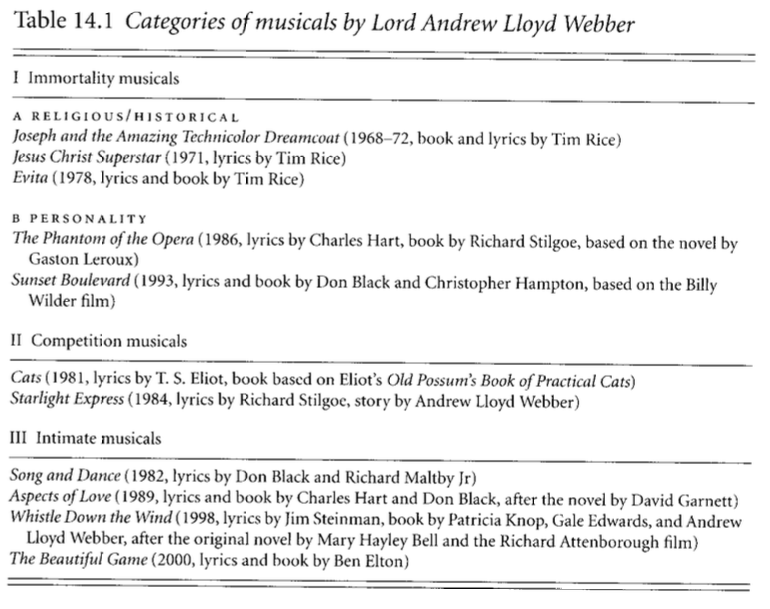
Screen Shot 2018-07-03 at 11.16.55 AMScreen Shot 2018-07-03 at 11.17.01 AM

  • Amusingly, the authors also note that Phantom and Sunset prominently feature both a staircase and monkey.

Bennett: “Theatre/Tourism” (2005)

“Theatre/Tourism” | Susan Bennett

Precis

Bennett concludes her article by framing it as a “prolegomenon,” which feels entirely appropriate to the spirit of the piece. She does not so much advance an argument about theatre tourism as she argues for its importance in cultural studies. The weight of this manifesto rests with the notion that the significance of theatre tourism lies not with its artistic value, per se, but with what it contributes to the “literally and symbolically” to its commercial context. Though most of the article is spent outlining the histories of theatre tourism in New York and Las Vegas, the essential purpose of the piece is to introduce the questions that future scholars may answer.

How does a tourist economy affect show development? What is the impact of the globally mobile audience base on the theatre industry? How are jobs and careers impacted by sustained commercial theatre?


Argument

Tourism and commercial theatre have long been dismissed by scholarship, but they constitute an essential component of the modern theatre landscape and deserve further scrutiny.


Methods

draws extensively on statistics and histories. generally forms a historical account of two tourist cities, with attendant observations.


Chapter Outline

Intro

  • Scholarship has neglected commercial theatre (407)
  • ★ “My argument here, then, is that this scholarly myopia has very real consequences for the project of inclusivity and, indeed, how we devise our approaches to understanding contemporary theatre and performance in both its production and reception contexts. To make the case for this differently inclusive account, I will look at a variety of [popular] theatrical productions… to suggest some of the questions and challenges for theatre studies that they bring into view.” (408)
  • Commercial theatre lives in urban spaces, with demand for high volume of spectators—>”local audiences cannot sustain such marathon runs” (409)
  • Tourist audience framed as “alien culture”, marked as an antithesis to committed/cultured spectatorship, as a necessary economic evil (409)
  • ★ Project: how do we understand audience appeal and the “very real pleasures” of cultural tourism? (410)
    • Cultural tourism: “instrumental use of places, people, and activities as commodities for the market”
  • “For tourism, theatre’s importance may not be the artistic product per se but what it contributes literally and symbolically to the contextual commercial environment.” (412)

New York

  • 1980’s decline of Broadway –> 1990’s regeneration of Times Square
    • From a center for crime/sex/drugs, Disney investment produced a snowball effect (413-14)
  • entertainment retail: begins with megamusicals and their retail spinoffs, continues with Disney and The Lion King—part of an ecological system at the center of which is the show (414)
  • Further evidence for Broadway’s increased significance in NYC tourism:
    • Ticket center contained within Times Square Visitors Center, TKTS –> access, potential spontaneity, community among purchasers
    • Online communities foster tourist conversation (415-16)
  • Import/Export relationships
    • “One country’s national theatre is another’s commercial theatre” (417)
    • Broadway becomes part of NYC’s international tourist marketing
  • ★ Key question: What does this tourist economy mean for show development?
    • “Is a show now ever just a Broadway show is must it be conceived with an eye to its future transnational currency? … How do audiences translate their experience of a [touring show] to pleasure in the actual Broadway experience?” (418)

Las Vegas

  • Framing Vegas
    • A city that “models the commercial profitability of entertainment retail to the world.” (418)
    • “Las Vegas performs America to the rest of the world, and the rest of the world to America.” / “It is… invested in the very fact of inauthenticity.” (419)
      • This inauthenticity is central to contemporary tourism
  • The Case of Cirque de Soleil
    • Cirque constructs an imagined universal address, “[effacing] performers’ ideological, cultural, and national placements” and omitting to introduce acts/performers in a breach of standard circus procedure (420-21)
    • Establishes a new bar for spectacular, globally oriented entertainment
    • Other hotels respond with further commercial theatre ventures: musicals, Blue Man Group, concert residencies (Celine Dion “create[s] her own universe” (422))
    • Cirque reverses circus tradition, making audiences migrate to permanent (purpose-built) theatres rather than the circus going on tour (423)
  • Vegas Tourism as Citational Practice
    • Lounge singer–>concert residencies, burlesque–>Zumanity (424)
    • +Retail opportunities before and after performance (424)

Conclusion

  • Audience is mobile as never before  (425)
  • Repertoires are structured to recognize tourist seasons (425)
  • Questions for commercial theatre
    • What king of jobs are created? How well do their pay? How do they figure into careers? Provides, perhaps, security

Key Terms

entertainment retail, universal address

Banfield: “Bit by Bit: 5 Ways…” (1994)

“Bit by Bit: Stephen Banfield finds five ways of looking at musicals” | Stephen Banfield

Precis

  1. Musical theatre is a form in which no single medium—”music, poetry, prose, dancing, acting, staging, costume” (220)—has the controlling interest.
    • Advertising may focus on any of these elements to draw the greatest audience
  2. Musicals operate as a commercial art form, tending to both the ephemeral and the heavily canonic
    • The “authentic” form of any given musical is impossible to locate (relate to: Swain on authenticity)
    • At least, musicals cannot be represented by a “tangible definite artefact” (221)
    • Still, shows are (largely) locked on opening night
  3. Musicals operate in the vernacular, using specific techniques
    • melopoetics (word-music), melokinetics (word-dance), wit
  4. The (American?) musical has a coherent history and generic profile
    • Musical theatre has diachronic history and synchronic generic spectrum
  5. Musical needs theory, for the synchronic spectrum
    • Bakhtin offers a start.

Screen Shot 2018-06-30 at 12.08.07 PM


Key Quotations

★ “Lines of authority run from the audience to the creators…” / “The problem with this is that what works with an audience changes greatly over the years, yet there is no mechanism giving a creator space or permission to essay a vision for posterity.

★ “To achieve immortality a musical has to sell things. … Critical adulation… [is] not enough.” (222)


Key Terms

melopoetics, melokinetics, diachronic, synchronic